French Translator Q&A
What made you want to be a translator and what was your journey to become one?
It started with a simple passion for languages, which led me to study them at university. My professional journey began in freelancing, where I initially explored many different fields. Over time, I naturally gravitated toward technical work, slowly specializing in engineering, where I found my niche.
What does a day in your life look like?
My day usually starts with waking up and immediately prospecting on platforms like ProZ to keep the pipeline full. Once the administrative side is handled—answering emails and organizing the schedule—I dive into work. A significant portion of my day is also dedicated to studying and reading news articles; staying on top of industry trends and world events is just as important as the translation itself.
How has the industry changed since you started working as a translator, and where do you see it going next?
The shift to Machine Translation has been massive. We are no longer just linguists; translators have had to become engineers who can juggle LLMs effectively. The focus has moved away from terminology research—which has become much easier—toward pure communication. The future lies in understanding intent perfectly and adapting it to the specific context. A good translator is now defined by their ability to grasp that intent and deliver on it seamlessly.
What do you think about the relationship between technology and translation?
Technology has been a constant companion throughout my career, but the intensity of that relationship has deepened. Fifteen years ago, it was strictly Translation Memories and termbases. Today, I’ve been working with AI and LLMs for over five years. Witnessing the progress year after year has given me a thorough understanding of the AI landscape and a significant competitive edge before most others in the field caught on.
What are the top 3 ‘tools’ from your translator arsenal that you can’t live without?
First, a robust CAT tool—I use Trados Studio. Second, a reliable Internet connection is non-negotiable. Finally, I rely on a suite of varied and performant LLMs that allow me to adapt specifically to the requirements of each task.
Do you prefer working alone in your own office/home, or sharing coworking spaces with others, and why?
I prefer working alone. High-quality translation requires deep concentration and an environment free of distractions.
What do you look for in your ideal client?
I value timely and efficient communication and, naturally, timely payments. Beyond the basics, I look for clients who offer interesting projects and show genuine respect for the work I do and the attention to detail I provide.
What should clients look for in their ideal translator?
Clients should look for impeccable attention to detail and strong communication skills. Crucially, they need a translator who possesses a very deep understanding of the modern world and the specific intricacies of the fields they are translating.
What’s one thing you wish more LSPs and end clients knew?
I wish there was more awareness regarding rates. They have been stagnating or going downhill because the work is perceived as “easier” thanks to new tools. However, many in the industry are lowballing significantly now. It’s important to remember that even though LLMs help, crafting a perfect translation still requires a massive amount of time, human skill, and research.
How important do you think the relationship between Project Manager and translator is?
It is central to the entire process. The Project Manager makes everything run smoothly and acts as the vital interface between the end client and the translator. That relationship is crucial to achieving the best possible results.
What kinds of jobs do you find the most challenging and why?
High-visibility jobs, such as translating press releases, are the most challenging. It is almost transcreation rather than translation. You have to fully grasp a brand’s image and convey it perfectly to a new audience, which requires a lot of analytical thinking and top-notch writing skills.
How do you look after yourself and cope with stressful days?
It is difficult not to overdo it as a freelancer, especially with the industry changing so rapidly. I admit I struggle with it sometimes because I love my work. However, I am also a semi-professional musician. The freedom that comes with freelancing allows me to tour around Europe and meet people, which is my main way of coping and decompressing.
What is it you like in particular about working for Andiamo?
The Project Managers are extremely friendly—I really enjoy working with Daisy and both Sarahs! The projects are consistently interesting, and I feel that my work is genuinely valued and respected here.
Everyone who works at Andiamo! is a massive animal lover, so this is a shameless call for you to please tell us about any pets you have! (Pictures highly encouraged.)
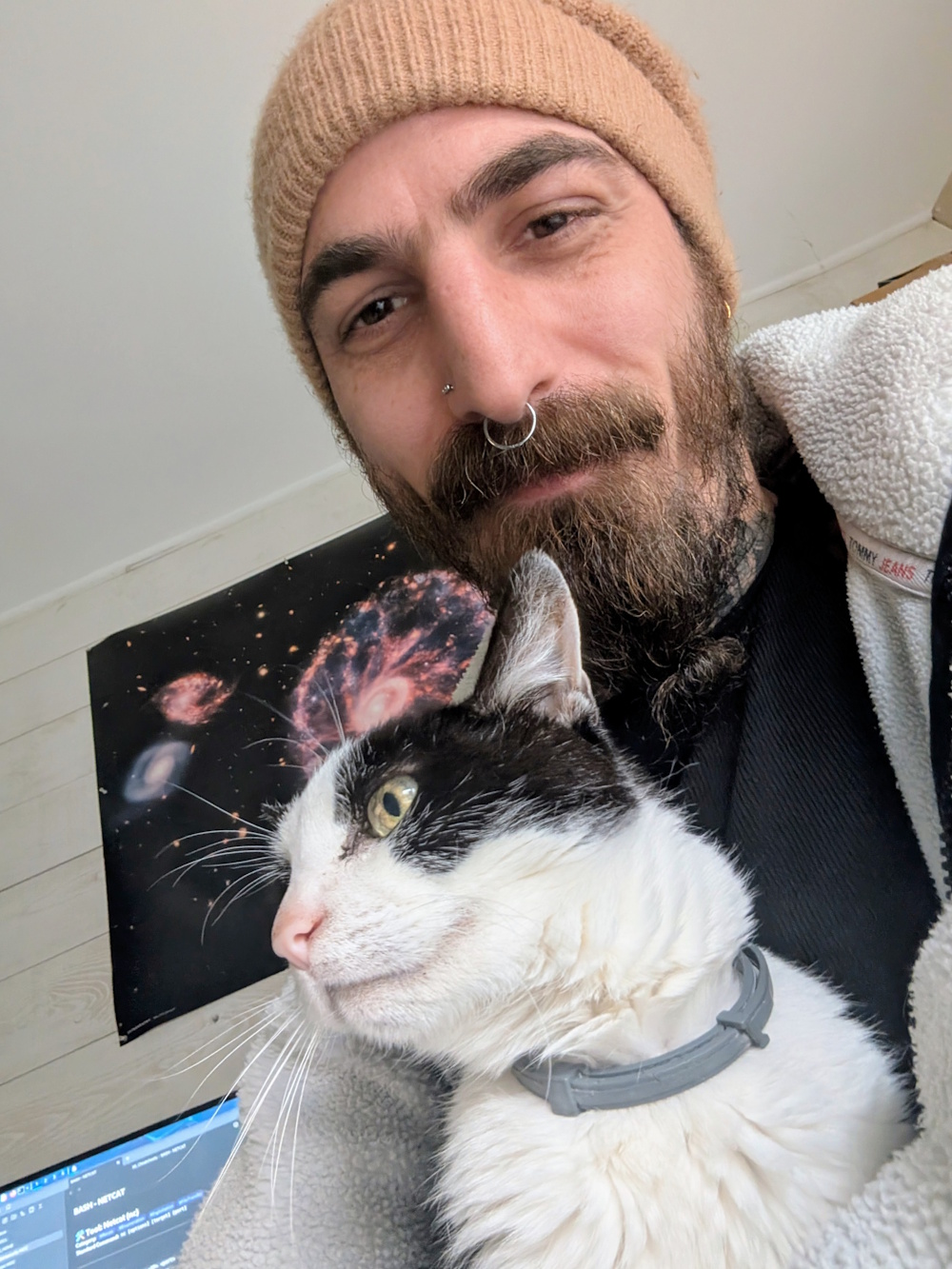
My little Fonzy is a 16-year-old rescue cat. I adopted him from a shelter when he was just two months old. He is very much a part of the workflow; he often sits on my lap while I work, reviewing my translations and nastily pointing out my errors with all the disdain you would expect from a cat!