Czech Translator Q&A
What made you want to be a translator and what was your journey to become one?
I was unsure about my career path until the last years of my university studies. The only thing I knew was that it needed to be something creative. Since I studied the Swedish language, translation seemed an obvious choice. I started out as a literary translator — I have translated three Swedish thrillers into Czech. Then I worked for a few years as an in-house proofreader in a local translation agency. Proofreading wasn’t really my calling, but I learned the ropes of using CAT tools, which I hadn’t even known existed until that point. In 2018, I shifted to game localization. Games are my passion, and I love the creativity and challenges that gameloc brings.
What does a day in your life look like?
I wake up around 7 AM, brew myself a cup of tea, and check my emails. After sorting through emails, it’s breakfast time. I usually cook a nice big bowl of oatmeal and watch some Let’s plays or book reviews on YouTube while I eat. Around 9 AM, my workday starts. I keep translating until about 4 PM (with a lunch break somewhere in between, of course), and then it’s time for the gym! After working out and running any errands, I may get back to work on my laptop, or relax with a book or a movie—or nowadays, a Twitch stream of some quality GTA V RP (it’s addictive, don’t judge me!).
How has the industry changed since you started working as a translator, and where do you see it going next?
These are turbulent times! I am very stubborn about declining all post-editing jobs. They are increasing in number, but I do not give in! First it was MTPE, now they call it AI, but I feel it’s essentially the same. Sometimes it can be a good tool for particular tasks, but it just doesn’t work as a replacement. The quality simply isn’t there yet… and the soul will never be there. The main problem I encounter is how to get this information across to the right places — the clients. I truly appreciate all my awesome clients who still value good old human translators over the new, attractive (and cheaper) machine solutions. I hope we will prevail!
What do you think about the relationship between technology and translation?
I feel like I partially answered this in the previous question. CAT tools are REALLY useful. What would I do without a translation memory, term bases, and automatic propagation of repetitions? Well, I would manage, but it’s just easier to have these things. AI, on the other hand — we are not friends yet. It is not helping or saving me time, quite the opposite. I am trying to stay up-to-date and use it occasionally for research and/or brainstorm purposes, so maybe this will change in the future. I can see myself using some kind of personalized AI trained on my translations, but I never want it to do the creative work instead of me. I enjoy my translation challenges in all their complexity!
What are the top 3 ‘tools’ from your translator arsenal that you can’t live without?
Firstly, it’s the Internetová jazyková příručka — an awesome online resource for every Czech linguist. It brings grammar rules together in one place, allows me to check vocabulary across multiple dictionaries, and confirm correct spelling, among many other things.
I have already mentioned translation memories and term bases, and of course, having a good English dictionary at hand always helps. And what would I do without Google, that helps me get to any resource I need?
Do you prefer working alone in your own office/home, or sharing coworking spaces with others, and why?
As an introvert, the home-alone lifestyle suits me best. I tried the office for several years, and it wasn’t for me. I like my peace, my freedom, my uniform (sweatpants and a comfy hoodie), and my cat’s company.
What do you look for in your ideal client?
My ideal client should be responsive, have a good understanding of translation work, and pays on time. I prefer a more personal, friendly style of communication over corporate business talk, so that’s also a huge plus.
What should clients look for in their ideal translator?
I would say: passion for the subject matter and a personal approach to each individual project — and meeting deadlines, of course!
What’s one thing you wish more LSPs and end clients knew?
I wish they would listen to their contractors and take their advice, because translators know best what works in their target language.
How important do you think the relationship between Project Manager and translator is?
When the relationship is good, friendly, and mutually respectful, there’s a much greater chance the collaboration will run smoothly and that the task will receive the care it deserves.
What kinds of jobs do you find the most challenging and why?
The transcreative ones — but I also love them the most, because I enjoy a good challenge! On the other hand, I am not a fan of post-editing or overly tedious proofreading that stifles creativity.
How do you look after yourself and cope with stressful days?
When I am stressed, my brain freezes, so I need to breathe, take a break, go to the gym or for a walk, vent to a close one, or hug a cat (if it lets you). I also went to therapy to learn how to manage my anxiety, and it helped a lot with work-related stress as well.
What is it you like in particular about working for Andiamo?
Andiamo is definitely one of my favourite clients! The PM team is absolutely lovely, the instructions are crystal clear, they always listen to any concerns or questions I might have (which can be quite a few, so kudos!), and there have simply been no issues whatsoever.
Everyone who works at Andiamo! is a massive animal lover, so this is a shameless call for you to please tell us about any pets you have! (Pictures highly encouraged.)
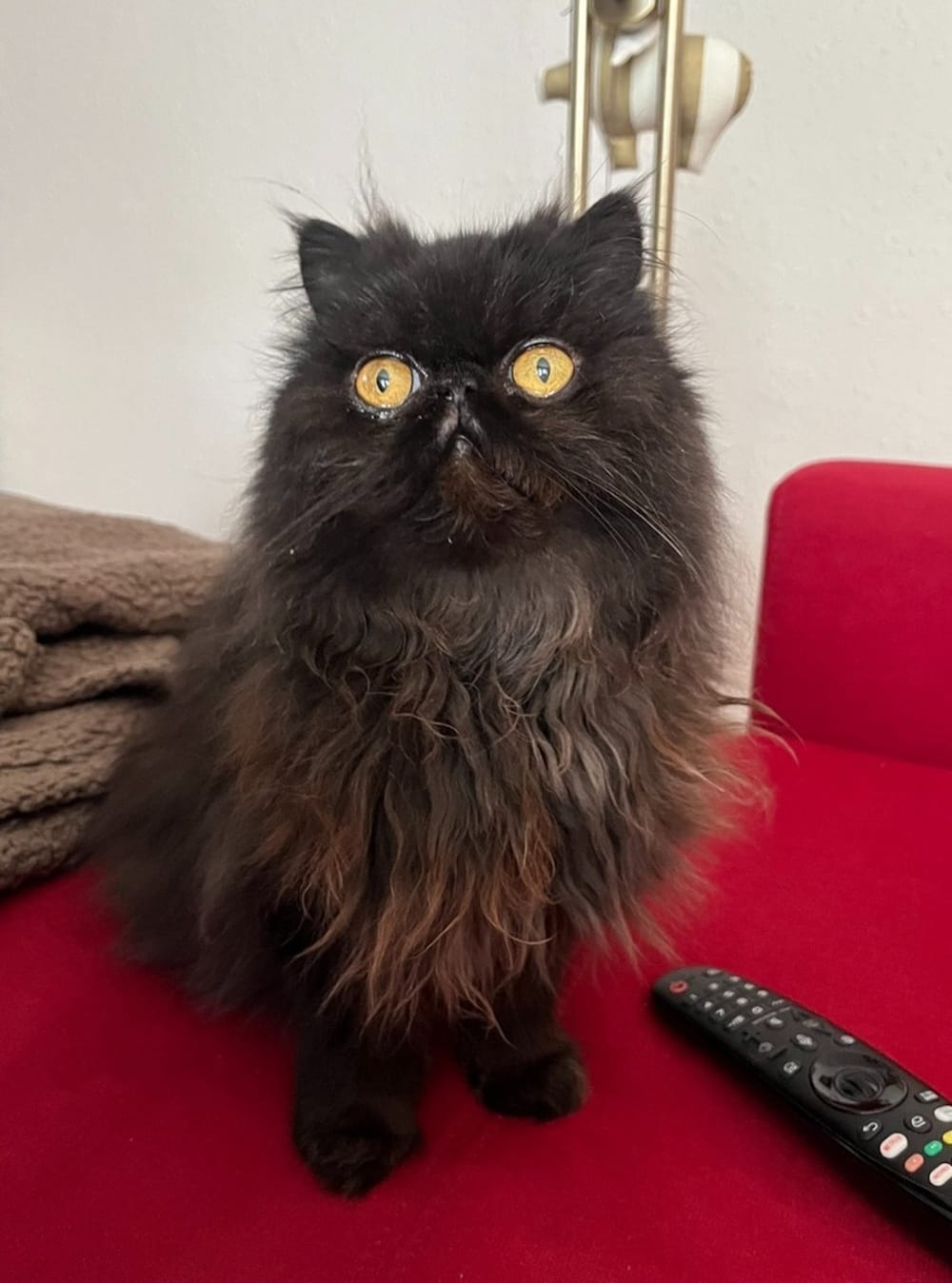
As an insane cat lady myself, let me introduce my old, grumpy grandma who shares the apartment with me. Her name is Bubo (because she looks a bit like an eagle owl, which is called Bubo bubo in Latin). She often reminds me to take a break (which is important for the brain!) and play with her. She says hi!